Architecture

Modern Python CLI Frameworks & Architecture

Choose frameworks, structure command trees, and design extensible, testable command-line systems that can scale with your product or team.

Modern Python CLI Frameworks & Architecture

Architecture & Framework Selection

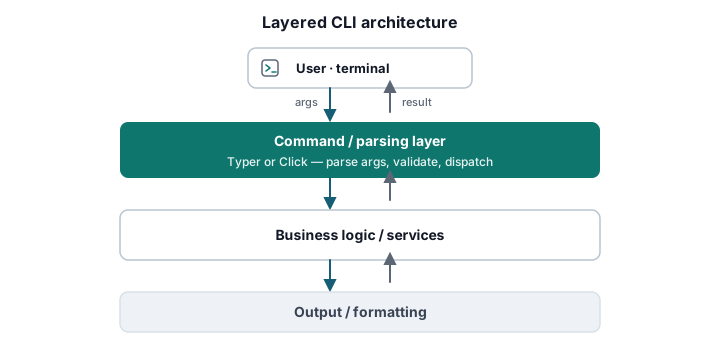
Production-grade command-line interfaces require deterministic routing and strict type enforcement. Decorator-heavy frameworks obscure data flow, while type-hint-driven architectures enable static analysis and IDE autocompletion. Evaluating Typer vs Click: When to Use Each clarifies trade-offs between rapid prototyping and enterprise maintainability.

Type-driven routing eliminates runtime parsing ambiguity. Python 3.10+ union syntax and typing.Annotated provide declarative validation without boilerplate.

# src/cli/commands.py
from __future__ import annotations
from typing import Annotated
import typer
from pathlib import Path

app = typer.Typer(add_completion=False)

@app.command()
def process(
 input_path: Annotated[Path, typer.Argument(help="Source data file")],
 threshold: Annotated[float, typer.Option(min=0.0, max=1.0)] = 0.85,
 verbose: Annotated[bool, typer.Option("--verbose", "-v")] = False,
) -> None:
 if not input_path.exists():
 raise typer.Exit(code=1, message=f"Missing: {input_path}")
 
 match threshold:
 case t if t < 0.5:
 typer.echo("Low threshold: aggressive filtering enabled.")
 case _:
 typer.echo(f"Processing {input_path} with threshold {threshold}")

Shared configuration and state management should leverage lightweight dependency injection. Avoid global singletons. Use factory functions or dependency-injector to wire database clients, HTTP sessions, and config loaders at application startup.

# src/cli/dependencies.py
from dataclasses import dataclass, field
from typing import Protocol

class ConfigProvider(Protocol):
 def get_api_key(self) -> str: ...

@dataclass(kw_only=True)
class ServiceContainer:
 config: ConfigProvider
 http_client: httpx.AsyncClient = field(default_factory=httpx.AsyncClient)

def build_container(env: str = "prod") -> ServiceContainer:
 return ServiceContainer(config=EnvConfigProvider(env=env))

Command Routing & Project Structure

Scalable CLI toolchains require explicit module boundaries and deferred execution. Monolithic command files degrade startup latency and complicate testing. Adopting Structuring Multi-Command Python CLIs isolates subcommands into dedicated packages.

Centralize build metadata and entry points in pyproject.toml. Modern tooling expects declarative configuration over legacy setup.py.

# pyproject.toml
[build-system]
requires = ["hatchling"]
build-backend = "hatchling.build"

[project]
name = "data-toolchain"
version = "1.2.0"
requires-python = ">=3.10"
dependencies = [
 "typer>=0.9.0",
 "rich>=13.0",
 "httpx>=0.25",
]

[project.scripts]
dt-cli = "src.cli.main:app"

[tool.hatch.build.targets.wheel]
packages = ["src/cli"]

Implement lazy command loading to defer imports until invocation. This reduces cold-start overhead for large suites.

# src/cli/main.py
import typer
import importlib

app = typer.Typer()

@app.command()
def run(subcommand: str, **kwargs: object) -> None:
 # Lazy dispatch: only import when explicitly called
 module = importlib.import_module(f"src.cli.commands.{subcommand}")
 module.run(**kwargs)

Enforce strict __init__.py boundaries. Export only public APIs. Use relative imports within packages to prevent circular dependencies and namespace pollution.

Concurrency & Performance Engineering

I/O-bound CLI operations require non-blocking execution patterns. Synchronous subprocess calls and sequential HTTP requests create unacceptable latency. Review Async I/O in Python Command Line Apps for event loop configuration and graceful signal handling.

Modern frameworks support native async commands. Wrap network-bound operations in asyncio tasks and use asyncio.gather for parallel execution.

# src/cli/async_worker.py
import asyncio
import httpx
import typer

async def fetch_batch(urls: list[str]) -> list[dict]:
 async with httpx.AsyncClient() as client:
 tasks = [client.get(url) for url in urls]
 responses = await asyncio.gather(*tasks, return_exceptions=True)
 return [r.json() for r in responses if isinstance(r, httpx.Response)]

@app.command()
def sync_fetch(urls: list[str]) -> None:
 asyncio.run(fetch_batch(urls))

Profile execution paths before optimizing. Apply CLI Performance Profiling & Optimization to isolate memory leaks and CPU hotspots. Use py-spy for sampling and tracemalloc for allocation tracking.

# Install uv for deterministic environment provisioning
curl -LsSf https://astral.sh/uv/install.sh | sh

# Create isolated environment with pinned dependencies
uv venv .venv --python 3.10
source .venv/bin/activate
uv pip install -e ".[dev]"

# Profile startup and execution
py-spy record -o profile.svg -- python -m src.cli.main run ingest

Limit thread pool sizes to os.cpu_count(). Use asyncio.Semaphore to cap concurrent connections. Always close event loops explicitly in teardown hooks.

Extensibility & Plugin Systems

Enterprise CLIs require modular feature expansion without core code modification. Hardcoded logic prevents third-party contributions and slows release cycles. Implement Plugin Architectures for Extensible CLIs via standardized entry points and pluggy hook discovery.

Define hook specifications in the core package. Plugins implement matching signatures and register via pyproject.toml.

# src/cli/plugins.py
import pluggy
from typing import Protocol, runtime_checkable

hookspec = pluggy.HookspecMarker("data_toolchain")
hookimpl = pluggy.HookimplMarker("data_toolchain")

class PluginSpec:
 @hookspec
 def pre_process(self, config: dict) -> dict: ...
 
 @hookspec
 def post_transform(self, data: list[dict]) -> list[dict]: ...
# Plugin registration in pyproject.toml
[project.entry-points."data_toolchain.plugins"]
csv_exporter = "my_plugin:CSVExporter"
json_validator = "my_plugin:JSONValidator"

Discover and load extensions at runtime using importlib.metadata. Scale to enterprise requirements with Advanced Plugin Systems & Extension APIs for versioned contracts and execution sandboxing.

# src/cli/loader.py
from importlib.metadata import entry_points
import pluggy

def load_plugins() -> pluggy.PluginManager:
 pm = pluggy.PluginManager("data_toolchain")
 pm.add_hookspecs(PluginSpec)
 
 eps = entry_points(group="data_toolchain.plugins")
 for ep in eps:
 pm.register(ep.load())
 return pm

Validate plugin compatibility through automated integration test matrices. Enforce semantic version constraints on hook interfaces. Reject incompatible plugins during initialization.

Testing & Quality Assurance

CLI behavior must be validated across environments before distribution. Mock sys.argv, standard I/O streams, and external API calls using deterministic pytest fixtures.

# tests/test_cli.py
import pytest
from typer.testing import CliRunner
from src.cli.main import app

runner = CliRunner()

def test_process_command_success(tmp_path: pytest.TempPathFactory) -> None:
 input_file = tmp_path / "data.csv"
 input_file.write_text("id,value\n1,100\n")
 
 result = runner.invoke(app, ["process", str(input_file), "--threshold", "0.9"])
 assert result.exit_code == 0
 assert "Processing" in result.stdout

Implement snapshot testing to prevent unintended stdout/stderr regressions. Use pytest-snapshot to capture terminal output and fail on structural changes.

# Generate initial snapshots
pytest tests/ --snapshot-update

# Run regression checks
pytest tests/ --snapshot-warn-unused

Enforce static analysis with mypy, ruff, and pre-commit hooks. Catch type mismatches and formatting drift before merge.

# .pre-commit-config.yaml
repos:
 - repo: https://github.com/astral-sh/ruff-pre-commit
 rev: v0.1.6
 hooks:
 - id: ruff
 args: [--fix]
 - id: ruff-format
 - repo: https://github.com/pre-commit/mirrors-mypy
 rev: v1.7.0
 hooks:
 - id: mypy
 additional_dependencies: [types-requests, types-toml]

Run test matrices across Python 3.10, 3.11, and 3.12. Validate cross-platform path resolution and encoding handling.

Packaging & Distribution

Deliver reproducible binaries and wheel artifacts across target operating systems. Configure modern build backends within pyproject.toml to eliminate legacy packaging friction.

[tool.hatch.build.targets.sdist]
include = ["src/cli", "pyproject.toml"]

[tool.hatch.build.targets.wheel]
packages = ["src/cli"]

Generate standalone executables using PyInstaller, shiv, or pex for zero-dependency deployment. shiv produces lightweight zipapps ideal for containerized environments.

# Install shiv
uv pip install shiv

# Build executable zipapp
shiv -c dt-cli -o dist/dt-cli.pyz .

# Verify execution
./dist/dt-cli.pyz --version

Automate CI/CD pipelines for cross-platform wheel compilation and registry publishing. Use GitHub Actions to trigger builds on tag pushes.

# .github/workflows/release.yml
name: Release
on:
 push:
 tags: ["v*"]

jobs:
 build-and-publish:
 runs-on: ubuntu-latest
 steps:
 - uses: actions/checkout@v4
 - uses: astral-sh/setup-uv@v1
 - run: uv build
 - run: uv pip install twine
 - run: uv run twine upload dist/*
 env:
 TWINE_USERNAME: __token__
 TWINE_PASSWORD: ${{ secrets.PYPI_API_TOKEN }}

Implement semantic versioning and automated changelog generation. Use git-cliff or release-please to parse conventional commits and draft release notes. Distribute via PyPI, Docker registries, GitHub Releases, or internal artifact repositories. Validate installation integrity with pip hash and checksum verification.